
When it comes to breast enlargement scars, patients often have countless questions:
What do scars from breast augmentation look like? How big is a boob job scar? Do they go away? How long do they last?
Keep reading the article if you want to learn more about this topic!
Types of Breast Enlargement Scars and What They Look Like
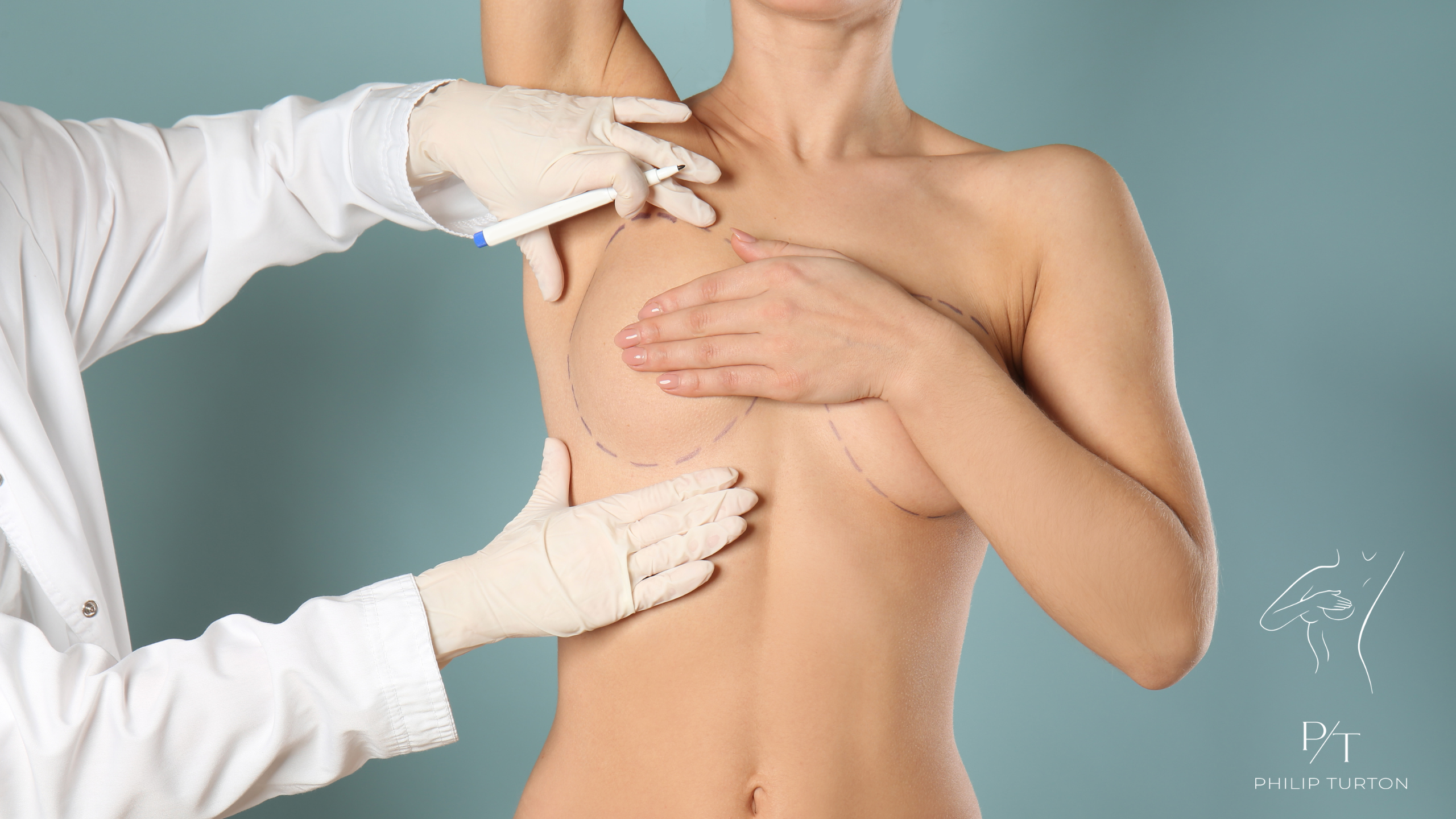
Your choice of incision during breast enlargement or Mastopexy (breast lift) directly affects the appearance and location of your scar.
Each method carries its own visual and healing characteristics.
Inframammary (Under-Breast) Incision
An under-breast incision scar is created in the inframammary fold, the natural crease beneath the breast.
This is the most common and anatomically strategic location. Incision lengths typically range from 4–6 cm, averaging around 5.2 cm. Although advanced techniques with a very narrow range of remote filled saline implants can theoretically allow incisions as small as ~1.7 cm.
Initially pink or reddish, the scar gradually fades to a thin, pale line usually hidden in the fold—barely noticeable when standing, more visible when lying down. After one year, many patients report only a fine, subtle line, indicating maturation.
Scar behavior and tissue
During healing, it’s common to experience scar tissue under the breast incision, which may feel firm or raised for several months. The deep suture material, is slowly reabsorbed and it is only after this period that final maturation and softness will return.
Monitoring during this early 8-weeks period is crucial to detect complications like inflammation, or capsular contracture, though the inframammary approach actually reduces bacterial exposure compared to periareolar methods.
Periareolar Incision
This incision circles the border of the areola. Because the incision traverses pigmented skin, scars tend to blend seamlessly.
Depending on areola size, surgeons use around 4–5 cm for silicone implants.
Be aware—this incision may impact nipple sensation or breastfeeding and carries a slight increase in capsular contracture risk . It is less commonly used.
Transaxillary and Transumbilical Incisions
Much less popular options include transaxillary (armpit) and transumbilical (navel or TUBA). The transaxillary incision leaves a scar in the armpit, invisible on the breast but possibly noticeable with sleeveless clothing. It transects important breast lymphatic pathways,
TUBA leaves no breast scar but is only applicable for certain types of saline implants; is technically challenging, and may offer less precision—often requiring revision through an inframammary incision.
Anchor, Lollipop, and Inverted‑T Incisions (Breast Lift Scars)
If Mastopexy—with or without implants—is performed, more extensive scars are involved:
- Anchor incision breast lift scar (full mastopexy): a periareolar circle, a vertical limb, and a horizontal scar in the inframammary fold. Suitable for moderate and all severe sagging . Gives great control to the skilled specialist surgeon to re-shape your breasts. The deep plane approach is the most advanced technique with full glandular mobilisation to restore the correct anatomical footprint to your breast.
- Lollipop lift (inverted‑T incision breast lift scar vertically): Circle around the areola plus a vertical line to the crease. Suitable for minor drop.
- Donut (Benelli) or crescent techniques: More limited scarring; donut involves a circular scar with an outer ring excised, while crescent uses a small arc above the areola . Suitable for minor drop and adjustments to asymmetrical nipple height, or reducing broad areolae.
These mastopexy scars are more noticeable initially but flatten and fade significantly over 12–18 months with proper care.
Healing Timeline & Factors Affecting Scarring
Understanding the scar timeline helps you anticipate changes and improve outcomes.
Typical Scar Healing Process
- Weeks 1–4: Scars appear red, raised, and firm. Swelling and bumpiness are common.
- Months 1–6: The scar begins flattening and fading, shifting to pink or flesh tone.
- After 1 Year: Scars usually mature—thin, flat, and pale, though individual results vary .
What Does Breast Augmentation Scars After 1 Year Look Like?
Attenuated and discreet—especially in inframammary folds or around the areola. Under optimal care, most scars are hardly noticeable.
However, anchor or inverted‑T scars may remain slightly visible but typically fade and smooth out.
Key Influencing Factors
- Genetics: Those prone to hypertrophic scars or keloids may scar more visibly.
- Incision quality & technique: Smaller, tension-minimized cuts (e.g., 1.7 cm inframammary) heal better.
- Post-op care: Sun protection, hydration, compression, correct garments, and avoiding skin tension matter.
- Lifestyle: Smoking, poor nutrition, and certain medications or health issues slow healing.
Scar Treatment After Breast Enlargement
While many scars heal nicely on their own, treatments can refine results further.
Let’s explore options from conservative to advanced.
Conservative & At-Home Treatments
- Silicone sheets and gels: Help flatten and fade scars efficiently.
- Massage therapy: Once healed, and sutures dissolve, gentle scar massage breaks down adhesions and promotes suppleness.
- Sun protection: Exposure can permanently darken scars. Use broad-spectrum SPF 50+ or clothing. Avoid sun beds.
- Moisturizers: Shea butter or vitamin E creams support skin hydration and elasticity.
Professional Interventions
- Laser therapy: Targets redness (vascular lasers) or texture (fractional resurfacing).
- Steroid injections: Used for hypertrophic or keloid scars to help flatten them.
- Microneedling: Stimulates collagen for better texture and scar blending.
- Scar revision surgery: In rare cases, especially with inverted‑T scars or significant conspicuousness.
Choosing the Best Treatment for Scars After Breast Enlargement
A phased approach is optimal: start with topical silicone + sun protection, then progress to laser or injections if needed after 6–12 months.
For specific conditions like fat transfer breast augmentation scars, treatments are similar—expect small donor-site scars but no implant-related incisions.
Breast enlargement scars may feel daunting at first, but with optimal incision choices, skilled surgical technique, and vigilant aftercare, they evolve into discreet, acceptable lines that don’t detract from your results.
Whether you opt for minimal scars with inframammary folds or undergo a lift with more extensive anchor incision breast lift scars, patience, protection, and proactive treatment ensure the best possible appearance over time.
For personalised guidance and state-of-the-art scar care, reach out to Mr. Turton’s team and schedule a consultation.