
Breast Implant Catalogues
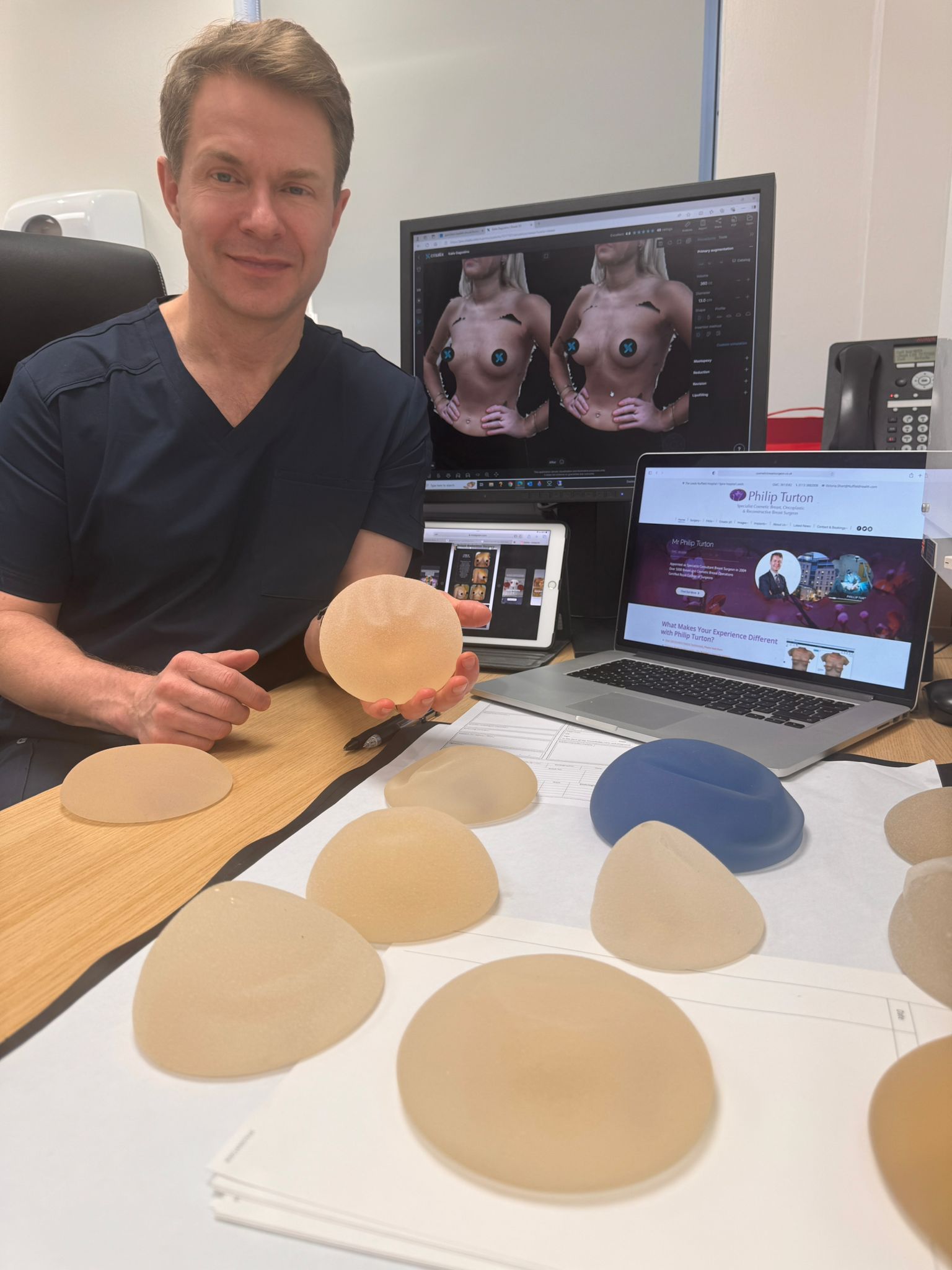
With years of experience in breast augmentation, revision, and reconstruction, Mr. Turton has compiled a library of both current and historical breast implant catalogues to assist in understanding various implant options.
About the implant catalogue
This database includes manufacturers like Mentor, Motiva and Nagor.
It also shows the previous catalogues of Manufacturers whose implants are now withdrawn from the market such as McGhan, Inamed and Allergan and others like PIP.
This combined resource offers a valuable reference for anyone researching or managing breast implants, both old and new
Select a supplier for more information and PDF catalogues
Allergan
Allergan was historically a market leading silicone breast implant supplier for years. But in July 2019 it needed to withdraw further sales of its entire textured range of implants. It was a global pharmaceutical leader who acquired Inamed breast implants in 2006. Allergan is now part of Abbvie.
Inamed in turn had previously acquired McGhan implants in 1986. The Allergan (Inamed or McGhan) silicone breast implant type typically used in Europe were the roughly textured type, which is termed “Biocell”.
The gel inside the implant is cohesive and depending on the type of implant it may be very firm (as in the anatomical range), intermediate (in the anatomical and round) or their softest gel (just in the round).
Allergan was widely regarded by a significant number of surgeons as having the best range of implants until restrictions in December 2018 and then the recall of their textured range from the market by the FDA in July 2019.
Patients who already have the implants are reassuringly advised by the FDA that they do not need to have them removed, something reiterated across the world by other regulators, including the MHRA in the UK. The smooth shell implants remain available on the market and are still widely used.
Inamed-McGhan-Implant-Catalogue-2004
B-Lite
B-Lite breast implants are manufactured by Polytech and distributed in the UK by Q Medical Technologies Ltd. They can be ordered with either a smooth outer shell or a textured outer shell, which is described by the company as a micro texture. They are available in round shapes with 3 different profiles and also in anatomical variants.
All of their implant ranges have a proprietary extra light weight silicone-borosilicate filler, making this implant range unique in being around 30% lighter than conventional breast implants.
These may help to tackle the issue of the effects of gravity on larger volume heavier implants on breast tissue.
These implants were introduced in 2015 by G&G Biotechnology, a company founded in 2005, and taken over by the prestigious German breast implant manufacturer Polytech Health & Aesthetics in 2018.
They are CE certified.
Eurosilicone
GC Aesthetics
I am now saying positive things about GC Aesthetics as it’s recently become my preferred brand of choice!
GCA Catalogue
GCA Brochure
Patient Information
Patient Consent Form
GCA Warranty
Ideal
Ideal implants are available in the USA as a high profile device with a silicone shell. Mr Turton has not seen these in the UK. They are a two-chamber implant with multiple sheets of solid silicone elastomer (the same material that the shell is made of) between the inner and outer chambers.
They have a part saline fill. The inner saline chamber is the larger of the two, and there are several solid silicone elastomer baffles (sheets of the silicone shell material) between the larger inner chamber and the smaller outer chamber. Instead of having one fill port as with conventional, single-chamber saline implants, there is an anterior fill port for the smaller outer chamber and a posterior fill port for the larger inner chamber.
As with conventional saline implants, the structured Ideal implant is inserted with one fill tubing attached to the outer chamber and another fill tubing attached to the inner chamber. Both chambers are filled once the implant is in place. They have had FDA approval since 2014.
Inamed / McGhan
These implants are synonymous with the Allergan implant range having been acquired by Allergan in 2006. The original range of round implants came as a standard profile called the 110, or a higher profile called the 120.
The matrix of anatomical implants was huge and provided surgeons and patients with a massive choice to tailor the implant to their unique dimensions. The most popular texture of the implants used from this range in Europe was the “Biocell” type.
This is now withdrawn (see information above). They also made a variety of tissue expanders that were usually used for 2-stage “expander-implant” based breast reconstruction.
Inamed also acquired another implant manufacturer called CUI (Cox-Uphoff) in 1989 and sold the CUI implant brand alongside the Inamed-McGhan range, although it was an entirely different product with a different texture and had a different gel-fill amongst other characteristics.
CUI implants are no longer approved and have been completely withdrawn from the market.
Mentor
Mentor Worldwide LLC is a major American implant manufacturer with a long track record, and established mature safety data. They produced the MemoryGel breast implant range since 2006 and more recently added the MemoryGel Xtra range too (allows for increased projection, fullness and firmness without losing the soft, natural feel patients desire).
Johnson and Johnson acquired Mentor implants in 2009. These implants have either a smooth or microtextured silicone outer shell. The inner part is filled with Mentor’s proprietary cohesive silicone gel.
The Mentor breast implant range includes a wide selection of round implants in varying profiles and also anatomical shapes in different profiles. They have had FDA approval for almost two decades.
They are CE Certified for use in the UK and are a market leading brand throughout hospitals in England.
Motivor
In September 2012, VeriTeQ entered into a development and supply agreement with Establishment Labs to produce the Motiva Implant Matrix brand which is available as a smooth, very lightly textured or micro-textured shell.
They are filled with silicone gel. They can be purchased with a microchip inside the implant that uses radio frequency transmission to signal what type of implant is in the patient.
They may be round, oval or contoured in shape. They received European CE mark approval at the end of 2013. They have recently received Pre Market Approval by the FDA.
Nagor
Nagor implants are made in the UK but are now owned by GC Aesthetics who also own the Eurosilicone range.
These implants may come with a textured or smooth surface, in round or anatomical shapes, with silicone or saline. They have CE mark certification and fall under the umbrella company GC Aesthetics.
The textured implants were withdrawn in France and suspended in Australia in 2019. They are still available in the UK.
PIP Immplants
These were withdrawn after fraudulent manufacturing practices were uncovered. The original catalogue serves as a guide for identifying these implants during revision procedures.
Poly Implant Prosthese (PIP)
PIP implants were withdrawn due to the fraudulent manufacturing of the product. See pages on this web site about PIP.
This is the original catalogue, which may serve to help surgeons identify the product or to facilitate obtaining the size information when planning an exchange of PIP implants to another manufacturer’s implants.
Polytech
Polytech Health and Aesthetics is a large German implant manufacturer. They are made with smooth, microtextured or polyurethane coated shells, in round and anatomical shapes.
The implants have CE mark certification. They also now own the BLite implant product range.
Sebbin
Groups Sebbin is a French Company that makes a variety of breast implants and tissue expanders.
The implants include round and anatomical variants, with a silicone gel or saline filler. They have a variety of profiles and sizes.
The implants have CE mark certification.
Sientra
Sientra’s breast implants were previously manufactured by Slimed in Rio de Janeiro, Brazil, but more recently are manufactured in the USA. They were originally approved by the FDA in 2012. Sientra added a tradename to its portfolio of breast implants “Sientra OPUS” in 2017. Sientra implants come in round and anatomical shapes, with smooth or textured shells in a broad selection of sizes, profiles, and projections.
Silimed
Silimed is an extremely popular, leading implant brand for women who want a beautiful enhancement. Their implants have been designed around the patient- the Silimed Biodesign. This is because there is no single ideal breast implant. Women have different chest widths, tissue characteristics and proportions. The Silimed range is ideal for this, with their extensive range of different implant dimensions, shapes and projections. This allows me to approach breast augmentation in the way I believe it should be approached. ‘Designing the breast first’ then selecting the implant that will help me create it.’
Your implant can therefore be selected according to your individual breast and chest dimensions, your existing breast tissue and the result that you and I are trying to achieve. Silimed Biodesign gives me incredible freedom to manipulate these variables. The range contain Silimed’s HSC+ high-performance cohesive silicone gel. It has advanced cohesivity but maintains such a natural feel. Softness plus a superior shape.
Why Implant Identification Matters
Knowing your breast implant’s manufacturer, style, size, and serial number is critical for future procedures or medical consultations.
For patients with implants placed after 2016, the National Breast Implant Registry stores this information, ensuring accessibility.
However, for older implants, records might need to be retrieved from the original hospital or surgeon.
Choosing the Right Implant: An Expert’s Perspective
Knowing your breast implant’s manufacturer, style, size, and serial number is critical for future procedures or medical consultations.
For patients with implants placed after 2016, the National Breast Implant Registry stores this information, ensuring accessibility.
However, for older implants, records might need to be retrieved from the original hospital or surgeon.